IoT Levels – Level 6 Architecture
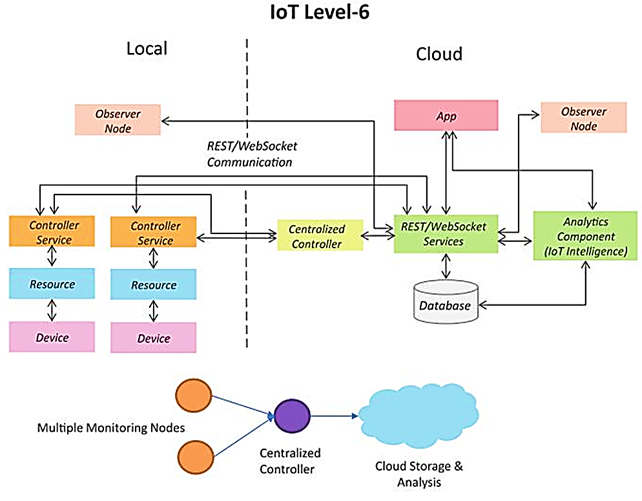
IoT Level-6
A Level-6 IoT system has multiple independent end nodes that perform sensing and/or actuation and send data to the cloud. Data is stored in the cloud and application is cloud-based as shown in Figure 1.11. The analytics component analyzes the data and stores the results in the cloud database. The results are visualized with the cloud-based application. The centralized controller is aware of the status of all the end nodes and sends control commands to the nodes.
Fig. 1.11: IoT Level-6.
Working of IoT Level-6
A Level-6 IoT system consists of multiple independent IoT end nodes that communicate directly with the cloud. Each node performs sensing and/or actuation independently and transmits the collected data to the cloud in real time.
The cloud provides centralized services for:
- Data storage
- Data analytics
- Visualization
- Device management
The analytics component processes the collected data, extracts useful information, and stores the analysis results in the cloud database. The cloud-based application visualizes these results for users.
Unlike Level-5, where a coordinator node acts as a gateway, Level-6 has no coordinator node. Instead, every end node communicates directly with the cloud.
A centralized controller, located in the cloud, continuously monitors the status of all connected IoT devices. Based on the analysis results, it sends control commands back to the respective end nodes whenever required.
Example: Weather Monitoring System
Let us consider an example of a Level-6 IoT system for weather monitoring.
The system consists of multiple nodes placed in different locations for monitoring temperature, humidity and pressure in an area.
The end nodes are equipped with various sensors such as:
- Temperature sensor
- Humidity sensor
- Pressure sensor
The end nodes send the data to the cloud in real time using a WebSocket service.
The data is stored in a cloud database.
The analysis of data is performed in the cloud to aggregate the data and make predictions.
A cloud-based application is used for visualizing the data.
Features of IoT Level-6
- Multiple independent IoT end nodes
- Direct communication between end nodes and the cloud
- No coordinator or gateway node
- Cloud-based data storage
- Cloud-based analytics
- Cloud-based application
- Centralized controller for device management
- Real-time communication
- Suitable for large-scale IoT deployments
- Supports predictive analytics and intelligent decision-making
Applications of IoT Level-6
Some common applications of IoT Level-6 include:
- Weather monitoring systems
- Smart city infrastructure
- Environmental monitoring
- Traffic monitoring
- Air quality monitoring
- Water quality monitoring
- Smart utility management
- Large-scale industrial monitoring
IoT Level-6 is designed for large-scale distributed IoT systems where multiple independent devices communicate directly with cloud services. The cloud performs centralized storage, advanced analytics, visualization, and device management, while the centralized controller enables intelligent monitoring and control of all connected IoT devices.
More from "IoT And Its Applications"
Machine-to-Machine (M2M) Communication
Learn about Machine-to-Machine (M2M) communication, its architecture, M2M gateways, communication networks, and applications in modern IoT systems.
IoT Levels – Level 5 Architecture
Learn about the architecture, working, and applications of IoT Level-5 systems, where multiple end nodes communicate through a coordinator node for cloud-based storage, analytics, and monitoring.
IoT Levels – Level 4 Architecture
Learn about the architecture, working, and applications of IoT Level-4 systems, where multiple IoT nodes perform local analysis while cloud services provide centralized storage, analytics, and visualization.