Machine-to-Machine (M2M) Communication
1.6 Machine-to-Machine (M2M)
Machine-to-Machine (M2M) refers to networking of machines (or devices) for the purpose of remote monitoring and control and data exchange.
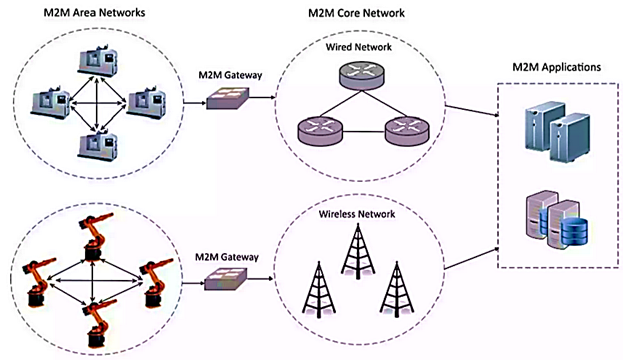
Figure 1.12 shows the end-to-end architecture for M2M systems comprising of M2M area networks, communication network, and application domain.
An M2M area network comprises of machines (or M2M nodes) which have embedded hardware modules for sensing, actuation and communication.
Various communication protocols can be used for M2M local area networks such as:
- ZigBee
- Bluetooth
- ModBus
- M-Bus
- Wireless M-Bus
- Power Line Communication (PLC)
- 6LoWPAN
- IEEE 802.15.4
These communication protocols provide connectivity between M2M nodes within an M2M area network.
The communication network provides connectivity to remote M2M area networks. The communication network can use either wired or wireless networks (IP-based).
While the M2M area networks use either proprietary or non-IP based communication protocols, the communication network uses IP-based networks. Since non-IP based protocols are used within M2M area networks, the M2M nodes within one network cannot communicate with nodes in an external network.
To enable the communication between remote M2M area networks, M2M gateways are used.
Fig. 1.12: M2M System Architecture.
M2M Gateway
Figure 1.13 shows a block diagram of an M2M gateway.
The communication between the M2M nodes and the M2M gateway is based on the communication protocols which are native to the M2M area network.
The M2M gateway performs protocol translations to enable IP connectivity for M2M area networks.
An M2M gateway acts as a proxy, performing translations from and to native protocols and the Internet Protocol (IP).
With an M2M gateway, each node in an M2M area network appears as a virtualized node for external M2M area networks.
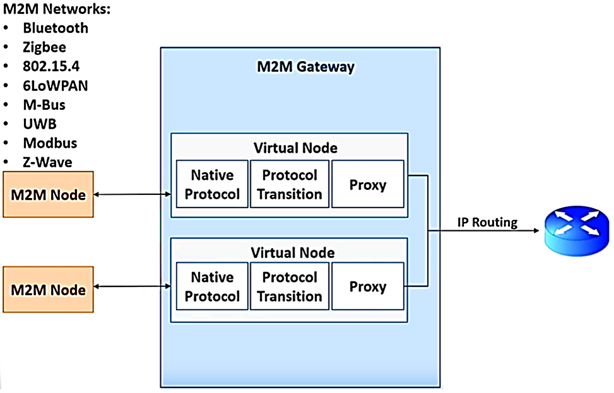
Fig. 1.13: Block Diagram of an M2M Gateway.
Components of an M2M System
An M2M system consists of the following major components.
M2M Area Network
The M2M area network consists of interconnected machines or devices that perform sensing, actuation, and communication within a local environment.
Communication Network
The communication network connects multiple M2M area networks using wired or wireless IP-based communication technologies.
M2M Gateway
The M2M gateway bridges the gap between local M2M networks and IP networks by translating communication protocols.
Application Domain
The application domain receives the data collected from M2M devices and provides services such as monitoring, control, analytics, and decision making.
Role of an M2M Gateway
The M2M gateway performs several important functions:
- Protocol translation
- Data aggregation
- Internet connectivity
- Device management
- Secure communication
- Communication between remote M2M networks
Without the gateway, devices using proprietary communication protocols cannot communicate over IP-based networks.
Applications of M2M
The M2M data is gathered into point solutions such as:
- Enterprise applications
- Service management applications
- Remote monitoring applications
M2M has various application domains such as:
- Smart metering
- Home automation
- Industrial automation
- Smart grids
M2M solution designs (such as data collection and storage architectures and applications) are specific to the M2M application domain.
M2M vs IoT
Although M2M and IoT are closely related, they differ in several aspects.
| Machine-to-Machine (M2M) | Internet of Things (IoT) |
|---|---|
| Device-to-device communication | Internet-based communication among devices, applications, and users |
| Usually application-specific | Supports multiple applications |
| Often uses proprietary protocols | Primarily uses Internet protocols (IP) |
| Limited scalability | Highly scalable |
| Focus on monitoring and control | Focus on intelligent data analysis and automation |
| Gateway enables IP connectivity | Devices often connect directly to cloud services |
M2M communication forms the foundation for many modern IoT systems. By enabling remote monitoring, control, and data exchange between machines, M2M technologies support a wide range of applications in industrial automation, smart infrastructure, energy management, healthcare, and home automation. The integration of M2M with cloud computing and Internet technologies has further expanded its capabilities, paving the way for the development of intelligent IoT ecosystems.
More from "IoT And Its Applications"
IoT Levels – Level 6 Architecture
Learn about the architecture, working, and applications of IoT Level-6 systems, where multiple independent IoT nodes communicate directly with the cloud and a centralized controller manages the entire system.
IoT Levels – Level 5 Architecture
Learn about the architecture, working, and applications of IoT Level-5 systems, where multiple end nodes communicate through a coordinator node for cloud-based storage, analytics, and monitoring.
IoT Levels – Level 4 Architecture
Learn about the architecture, working, and applications of IoT Level-4 systems, where multiple IoT nodes perform local analysis while cloud services provide centralized storage, analytics, and visualization.