IoT Levels – Level 2 Architecture
IoT Level-2
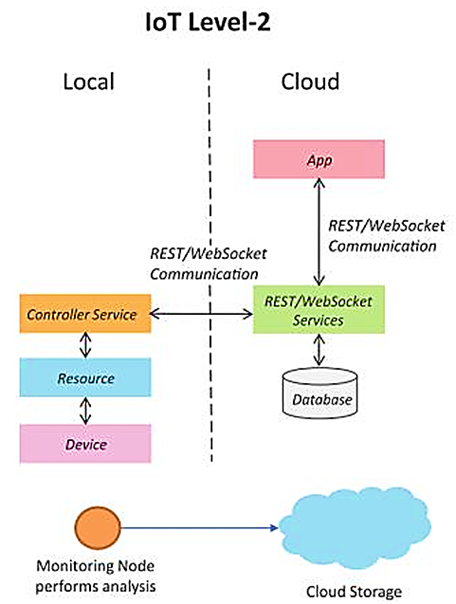
A Level-2 IoT system has a single node that performs sensing and/or actuation and local analysis as shown in Figure 1.7. Data is stored in the cloud and application is usually cloud-based. Level-2 IoT systems are suitable for solutions where the data involved is big. However, the primary analysis requirement is not computationally intensive and can be done locally itself.
Fig. 1.7: IoT Level-2.
Working of IoT Level-2
A Level-2 IoT system consists of a single IoT device that performs sensing, actuation, and local data analysis. Unlike a Level-1 system, the generated data is stored in the cloud instead of a local database. The application used for monitoring and controlling the system is also cloud-based, allowing users to access the system remotely from anywhere through the Internet.
Since the data is stored in the cloud, historical data can be maintained for visualization and analysis. However, the primary decision-making is still carried out locally by the IoT device, making the system suitable for applications where immediate responses are required but extensive cloud-based computation is unnecessary.
Example: Smart Irrigation System
Let us consider an example of a Level-2 IoT system for smart irrigation.
The system consists of a single node that monitors the soil moisture level and controls the irrigation system. The device used in this system collects soil moisture data from sensors.
The controller service continuously monitors the moisture levels. If the moisture level drops below a threshold, the irrigation system is turned on. For controlling the irrigation system, actuators such as solenoid valves can be used.
The controller also sends the moisture data to the computing cloud. A cloud-based REST web service is used for storing and retrieving moisture data, which is stored in the cloud database.
A cloud-based application is used for visualizing the moisture levels over a period, which can help in making decisions about irrigation schedules.
Features of IoT Level-2
- Single IoT device (single node)
- Performs sensing and actuation
- Local data processing and analysis
- Data stored in the cloud
- Cloud-based database
- Cloud-based application
- Remote monitoring through the Internet
- Suitable for applications generating large amounts of data
- Local decision-making with cloud-based visualization
Applications of IoT Level-2
Some common applications of IoT Level-2 include:
- Smart irrigation systems
- Environmental monitoring
- Smart water management
- Agricultural monitoring
- Weather monitoring stations
- Remote equipment monitoring
IoT Level-2 provides a simple yet effective architecture by combining local intelligence with cloud storage and remote visualization, making it suitable for many real-world IoT applications.
More from "IoT And Its Applications"
Machine-to-Machine (M2M) Communication
Learn about Machine-to-Machine (M2M) communication, its architecture, M2M gateways, communication networks, and applications in modern IoT systems.
IoT Levels – Level 6 Architecture
Learn about the architecture, working, and applications of IoT Level-6 systems, where multiple independent IoT nodes communicate directly with the cloud and a centralized controller manages the entire system.
IoT Levels – Level 5 Architecture
Learn about the architecture, working, and applications of IoT Level-5 systems, where multiple end nodes communicate through a coordinator node for cloud-based storage, analytics, and monitoring.