IoT Levels – Level 1 Architecture
IoT Levels
An IoT system comprises of the following components:
Device
An IoT device allows identification, remote sensing, actuating and remote monitoring capabilities.
Resource
Resources are software components on the IoT device for accessing, processing, and storing sensor information, or controlling actuators connected to the device.
Controller Service
Controller service sends data from the device to the web service and receives commands from the application (via web services) for controlling the device.
Database
Database can be either local or in the cloud and stores the data generated by the IoT device.
Web Service
Web services serve as a link between the IoT device, application, database and analysis components.
Analysis Component
The Analysis Component is responsible for analyzing the IoT data and generate results in a form which are easy for the user to understand.
Application
IoT applications provide an interface that the users can use to control and monitor various aspects of the IoT system.
IoT Level-1
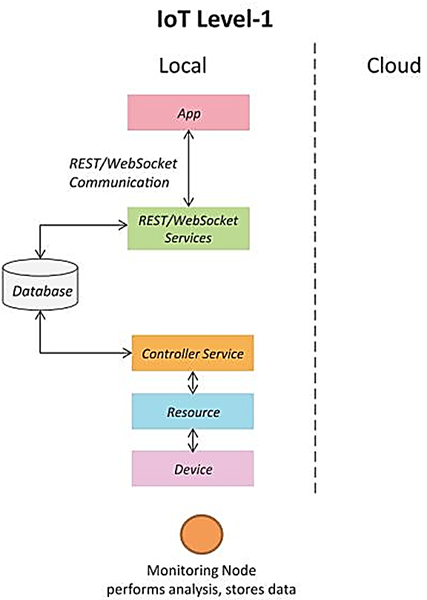
A Level-1 IoT system has a single node/device that performs sensing and/or actuation, stores data, performs analysis and hosts the application as shown in Figure 1.6. Level-1 IoT systems are suitable for modeling low-cost and low-complexity solutions where the data involved is not big and the analysis requirements are not computationally intensive.
Fig. 1.6: IoT Level-1.
Working of IoT Level-1
A Level-1 IoT system integrates all the major components of an IoT solution within a single device or node. The device performs sensing and/or actuation, stores the generated data, analyzes the data locally, and hosts the application used for monitoring and control.
Since all processing takes place within the same device, there is no dependency on cloud computing or external data processing services. This makes Level-1 systems simple, cost-effective, and suitable for applications with limited computational requirements.
Example: Home Automation System
Consider a Level-1 IoT system designed for home automation.
The system consists of a single node that allows controlling the lights and appliances in a home remotely. The device interfaces with the lights and appliances using electronic relay switches.
The status information of each light or appliance is maintained in a local database. REST services deployed locally allow retrieving and updating the state of each light or appliance in the status database.
The controller service continuously monitors the state of each light or appliance (by retrieving the state from the database) and triggers the relay switches accordingly.
The application, which is deployed locally, provides a user interface for controlling the lights or appliances. Since the device is connected to the Internet, the application can also be accessed remotely.
Features of IoT Level-1
- Single IoT device (single node)
- Local data storage
- Local data processing and analysis
- Application hosted locally
- Suitable for low-cost IoT solutions
- Suitable for applications with small amounts of data
- Minimal computational requirements
- Remote monitoring and control through Internet connectivity
Applications of IoT Level-1
Some common applications of IoT Level-1 include:
- Home automation
- Smart lighting systems
- Smart switches
- Small environmental monitoring systems
- Personal health monitoring devices
- Small office automation systems
IoT Level-1 provides the simplest architecture among all IoT deployment levels and is ideal for applications where a single device can independently perform sensing, processing, storage, and user interaction.
More from "IoT And Its Applications"
Machine-to-Machine (M2M) Communication
Learn about Machine-to-Machine (M2M) communication, its architecture, M2M gateways, communication networks, and applications in modern IoT systems.
IoT Levels – Level 6 Architecture
Learn about the architecture, working, and applications of IoT Level-6 systems, where multiple independent IoT nodes communicate directly with the cloud and a centralized controller manages the entire system.
IoT Levels – Level 5 Architecture
Learn about the architecture, working, and applications of IoT Level-5 systems, where multiple end nodes communicate through a coordinator node for cloud-based storage, analytics, and monitoring.