Oracle IoT Architecture

Oracle IoT Architecture
Figure 1.5 shows the Oracle IoT Architecture, which provides a comprehensive framework for connecting IoT devices with enterprise applications and cloud-based services. The architecture illustrates how data is collected from physical devices, transmitted through communication networks, processed, and finally transformed into useful business information.
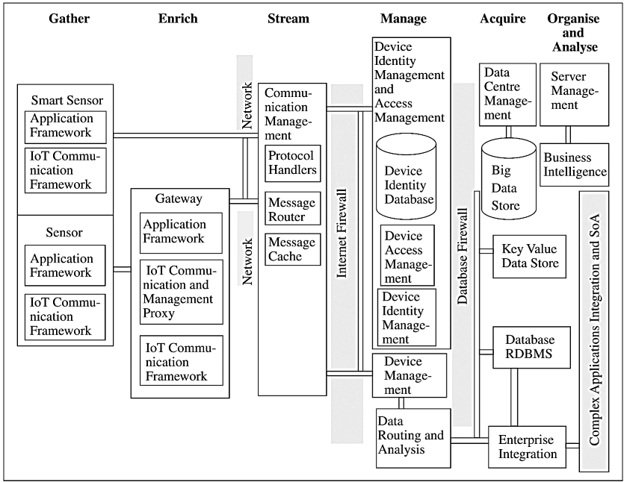
Fig. 1.5: Oracle’s IoT Architecture.
Features of Oracle IoT Architecture
The Oracle IoT architecture has the following features:
-
The architecture serves as a reference in applications of IoT in services and business processes.
-
A set of smart sensors captures the data, performs necessary data element analysis and transformation as per the device application framework, and connects directly to a communication manager.
-
A set of sensor circuits is connected to a gateway possessing separate data capturing, gathering, computing, and communication capabilities. The gateway receives the data in one form at one end and sends it in another form to the other end.
-
The communication management subsystem consists of protocol handlers, message routers, and message cache.
-
This management subsystem provides functionalities for device identity database, device identity management, and access management.
-
Data is routed from the gateway through the Internet and data centre to the application server or enterprise server, which acquires the data.
-
Organisation and analysis subsystems enable services, business processes, enterprise integration, and complex business operations.
Components of Oracle IoT Architecture
Smart Sensors
Smart sensors collect information from the physical environment. In addition to sensing, they can perform basic processing such as filtering and formatting data before transmitting it.
Examples include:
- Temperature sensors
- Humidity sensors
- Motion sensors
- Pressure sensors
- Smart energy meters
IoT Gateway
The gateway acts as an intermediary between IoT devices and the Internet.
Its responsibilities include:
- Collecting data from multiple sensors
- Protocol conversion
- Local data processing
- Data aggregation
- Secure communication with cloud servers
The gateway receives data from devices using one communication technology and forwards it using another suitable communication protocol.
Communication Management Subsystem
The communication management subsystem ensures reliable communication between IoT devices and enterprise applications.
It includes:
- Protocol handlers
- Message routers
- Message cache
- Device identity management
- Access management
This subsystem authenticates devices, manages communication sessions, and routes data to the appropriate destination.
Internet and Data Centre
The processed data is transmitted through the Internet to cloud infrastructure or enterprise data centres.
These platforms provide:
- Data storage
- High-performance computing
- Device management
- Data analytics
- Security services
Application Server / Enterprise Server
Application servers receive IoT data from the cloud or data centre and make it available for various enterprise applications.
Typical applications include:
- Smart manufacturing
- Healthcare monitoring
- Smart agriculture
- Smart city management
- Asset tracking
- Energy management
Organisation and Analysis
The final stage transforms raw IoT data into useful business information.
The organisation and analysis subsystem performs:
- Data analysis
- Business intelligence
- Enterprise integration
- Decision support
- Automation of business processes
The insights generated at this stage help organizations improve operational efficiency and support intelligent decision-making.
Data Flow in Oracle IoT Architecture
The flow of information in Oracle’s IoT Architecture can be summarized as follows:
Smart Sensors
      ↓
IoT Gateway
      ↓
Communication Management
      ↓
Internet
      ↓
Data Centre / Cloud
      ↓
Application / Enterprise Server
      ↓
Organisation & Analysis
      ↓
Services and Business Processes
Advantages of Oracle IoT Architecture
The Oracle IoT Architecture offers several advantages:
- Provides a scalable architecture for large IoT deployments.
- Supports secure communication between devices and enterprise applications.
- Enables real-time monitoring and remote device management.
- Facilitates enterprise integration and business process automation.
- Supports cloud computing and advanced data analytics.
- Improves operational efficiency through intelligent decision-making.
Oracle’s IoT Architecture serves as a practical reference model for designing enterprise-scale IoT systems by integrating sensing, communication, cloud computing, analytics, and business applications into a unified framework.
More from "IoT And Its Applications"
Machine-to-Machine (M2M) Communication
Learn about Machine-to-Machine (M2M) communication, its architecture, M2M gateways, communication networks, and applications in modern IoT systems.
IoT Levels – Level 6 Architecture
Learn about the architecture, working, and applications of IoT Level-6 systems, where multiple independent IoT nodes communicate directly with the cloud and a centralized controller manages the entire system.
IoT Levels – Level 5 Architecture
Learn about the architecture, working, and applications of IoT Level-5 systems, where multiple end nodes communicate through a coordinator node for cloud-based storage, analytics, and monitoring.