IoT Reference Models and Frameworks - CISCO

IoT Reference Models and Frameworks
An IoT system has multiple levels.
Framework for IoT with Connectivity to a Web Service
The framework for IoT with connectivity to a web service is:
Physical Object + Controller, Sensor and Actuators + Internet = Internet of Things
Framework for IoT with Connectivity to a Data Centre, Application or Enterprise Server
The framework for IoT with connectivity to a data centre, application or enterprise server for data storage, services and business processes is:
Gather + Enrich + Stream + Manage + Acquire + Organise and Analyse = Internet of Things
Framework for IoT Using Cloud-Based Services
The framework for IoT using cloud-based services is:
Gather + Consolidate + Connect + Collect + Assemble + Manage and Analyse = Internet of Things
IoT Reference Model
These levels are also known as tiers. A model enables conceptualisation of a framework. A reference model can be used to depict building blocks, successive interactions and integration.
One of the most widely accepted conceptual models for IoT systems is the Cisco Seven-Level IoT Reference Model. It provides a structured approach for understanding how data flows from physical devices to business applications and how decisions are communicated back to the devices.
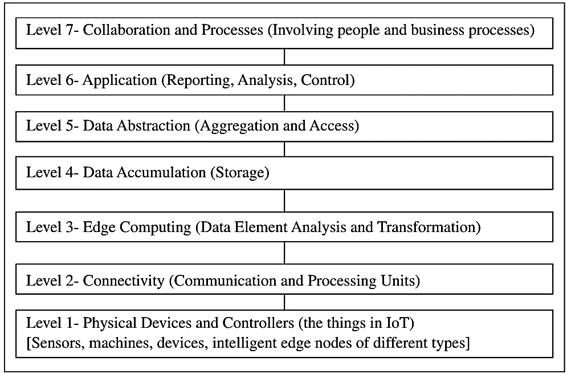
Fig. 1.4: Cisco Seven-Level IoT Reference Model.
Cisco Seven-Level IoT Reference Model
The Cisco IoT Reference Model consists of seven functional levels.
Level 1: Physical Devices and Controllers
This layer contains the physical “things” of the IoT system, including:
- Sensors
- Actuators
- RFID tags
- Smart meters
- Embedded controllers
- Industrial machines
These devices collect data from the physical environment or perform actions based on received commands.
Level 2: Connectivity
The connectivity layer is responsible for securely transmitting data between IoT devices and the network.
It includes communication technologies such as:
- Ethernet
- Wi-Fi
- Bluetooth
- ZigBee
- Cellular Networks
- LoRaWAN
This layer ensures reliable communication between devices and higher-level services.
Level 3: Edge Computing
Instead of sending all sensor data directly to the cloud, some processing is performed near the devices.
Typical functions include:
- Data filtering
- Data aggregation
- Event detection
- Protocol conversion
- Local decision making
Edge computing reduces communication delay and network bandwidth usage.
Level 4: Data Accumulation
This layer converts data streams into stored information.
Its functions include:
- Data collection
- Data storage
- Database management
- Cloud storage
The accumulated data becomes available for later analysis and processing.
Level 5: Data Abstraction
The stored data is processed and organized into meaningful information.
Functions performed include:
- Data normalization
- Data integration
- Analytics
- Visualization
- Data access services
This layer allows applications to retrieve useful information without dealing with raw sensor data.
Level 6: Applications
Application software uses the processed information to provide useful services.
Examples include:
- Smart home applications
- Smart healthcare systems
- Smart agriculture
- Industrial monitoring
- Fleet management
- Energy management systems
Users interact with IoT systems primarily through this layer.
Level 7: Collaboration and Processes
The highest layer integrates IoT information into business operations and decision-making.
Examples include:
- Business process automation
- Enterprise Resource Planning (ERP)
- Supply chain management
- Predictive maintenance
- Decision support systems
This layer transforms IoT-generated information into business value.
Advantages of the Cisco IoT Reference Model
The Cisco reference model provides several benefits:
- Clearly defines the responsibilities of each layer.
- Simplifies the design of complex IoT systems.
- Improves interoperability among different technologies.
- Supports scalability and modular system development.
- Enables easier integration with cloud platforms and enterprise applications.
The seven-layer architecture serves as a conceptual framework rather than a strict implementation model, helping engineers design scalable, secure, and efficient IoT solutions.
More from "IoT And Its Applications"
Machine-to-Machine (M2M) Communication
Learn about Machine-to-Machine (M2M) communication, its architecture, M2M gateways, communication networks, and applications in modern IoT systems.
IoT Levels – Level 6 Architecture
Learn about the architecture, working, and applications of IoT Level-6 systems, where multiple independent IoT nodes communicate directly with the cloud and a centralized controller manages the entire system.
IoT Levels – Level 5 Architecture
Learn about the architecture, working, and applications of IoT Level-5 systems, where multiple end nodes communicate through a coordinator node for cloud-based storage, analytics, and monitoring.