
Phase Relation in a Pure Inductor
Phase Relation in a Pure Inductor
The voltage-current relation in the case of an inductor is given by:
where:
- = inductance
- = current
- = voltage
Sinusoidal Current Through an Inductor
Consider the current function:
Differentiating with respect to time,
Substituting into the voltage equation,
Using the trigonometric identity,
Therefore,
Let,
Hence,
Phase Relationship
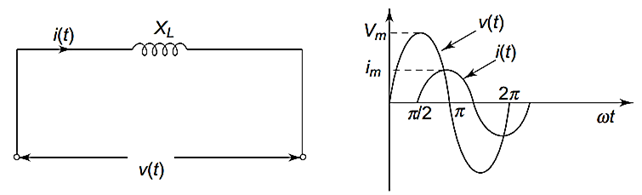
If we draw the waveforms for both voltage and current as shown in Fig. 2.11, we can observe the phase difference between these two waveforms.
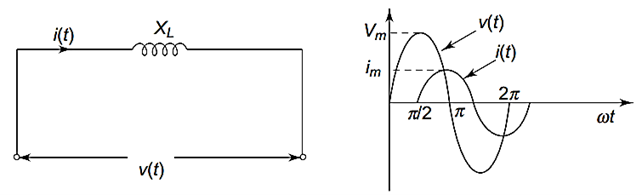
In a pure inductor, voltage and current are out of phase.
The voltage leads the current by:
or equivalently,
The current lags behind the voltage by .
Impedance of a Pure Inductor
The impedance is the ratio of voltage to current.
For a pure inductor,
The inductive reactance is represented by:
where:
- = inductance
Thus,
The impedance of a pure inductor is represented in complex form as:
or
Hence, a pure inductor has an impedance whose value is:
Characteristics of Pure Inductive Circuit
- Current lags voltage by .
- Impedance is purely imaginary.
- No real power is consumed.
- Energy is temporarily stored in the magnetic field.
- The average power over one complete cycle is zero.
Power in a Pure Inductor
Instantaneous power is:
Average power is:
For a pure inductor,
Since,
therefore,
Thus, a pure inductor consumes no average power.
Summary
- In a pure inductor, current lags voltage by .
- Voltage leads current by .
- The inductive reactance is:
- The impedance of an inductor is:
- A pure inductor stores energy in its magnetic field.
- The average power consumed by a pure inductor is zero.
More from "Basic Electrical Engineering"
Power in AC Circuits
An introduction to active power, reactive power, apparent power, and power relationships in AC circuits.
Series RLC Circuit
An introduction to series RLC circuits, impedance, phase angle, reactance, and AC circuit behaviour.
Series RC Circuit
An introduction to series RC circuits, impedance, phase angle, phasor relationships, and voltage-current analysis in AC circuits.