Physical Design of IoT: Things in the Internet of Things

Physical Design of IoT
Things in IoT
The “Things” in IoT usually refers to IoT devices which have unique identities and can perform remote sensing, actuating and monitoring capabilities. IoT devices can exchange data with other connected devices and applications (directly or indirectly), or collect data from other devices and process the data either locally or send the data to centralized servers or cloud-based application back-ends for processing the data, or perform some tasks locally and other tasks within the IoT infrastructure, based on temporal and space constraints (i.e., memory, processing capabilities, communication latencies and speeds, and deadlines).
Figure 1 shows a block diagram of a typical IoT device. An IoT device may consist of several interfaces for connections to other devices, both wired and wireless. These include:
- I/O interfaces for sensors
- Interfaces for Internet connectivity
- Memory and storage interfaces
- Audio/video interfaces
An IoT device can collect various types of data from the on-board or attached sensors, such as temperature, humidity, light intensity. The sensed data can be communicated either to other devices or cloud-based servers/storage. IoT devices can be connected to actuators that allow them to interact with other physical entities (including non-IoT devices and systems) in the vicinity of the device. For example, a relay switch connected to an IoT device can turn an appliance on/off based on the commands sent to the IoT device over the Internet.
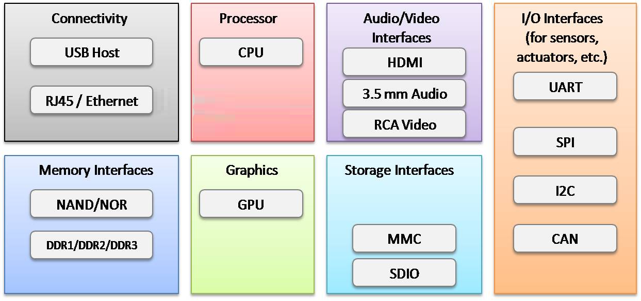
Fig. 1.1: Generic Block Diagram of an IoT Device
IoT devices can also be of varied types, for instance, wearable sensors, smart watches, LED lights, automobiles and industrial machines. Almost all IoT devices generate data in some form or the other which when processed by data analytics systems leads to useful information to guide further actions locally or remotely. For instance, sensor data generated by a soil moisture monitoring device in a garden, when processed can help in determining the optimum watering schedules. Figure 1.2 shows different types of IoT devices.
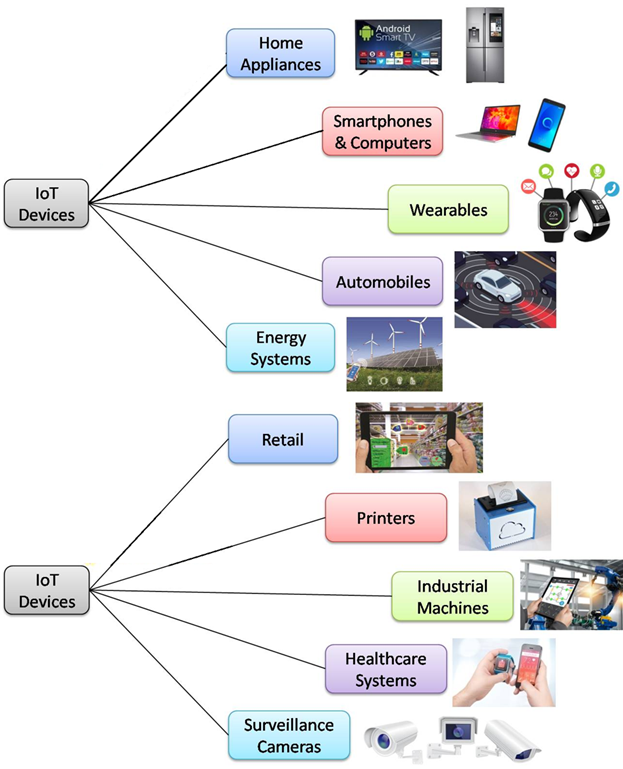
Fig. 1.2: IoT Devices
More from "IoT And Its Applications"
Machine-to-Machine (M2M) Communication
Learn about Machine-to-Machine (M2M) communication, its architecture, M2M gateways, communication networks, and applications in modern IoT systems.
IoT Levels – Level 6 Architecture
Learn about the architecture, working, and applications of IoT Level-6 systems, where multiple independent IoT nodes communicate directly with the cloud and a centralized controller manages the entire system.
IoT Levels – Level 5 Architecture
Learn about the architecture, working, and applications of IoT Level-5 systems, where multiple end nodes communicate through a coordinator node for cloud-based storage, analytics, and monitoring.