Link Layer Protocols for Internet of Things (IoT)

Link Layer
A protocol is a set of rules that governs the communication between two or more devices. A protocol defines the rules, syntax, semantics and synchronization of communication and possible error recovery methods.
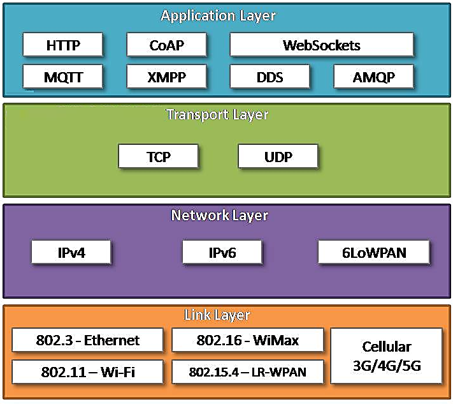
Link layer protocols determine how the data is physically sent over the network’s physical layer or medium (e.g., copper wire, coaxial cable, or a radio wave). The scope of the link layer is the local network connection to which host is attached. Hosts on the same link exchange data packets over the link layer using link layer protocols. Link layer determines how the packets are coded and signalled by the hardware device over the medium to which the host is attached (such as a coaxial cable). Let us now look at some link layer protocols which are relevant in the context of IoT.
IEEE 802.3 – Ethernet
IEEE 802.3 is a collection of wired Ethernet standards for the link layer.
For example:
- 802.3 is the standard for 10BASE5 Ethernet that uses coaxial cable as a shared medium.
- 802.3i is the standard for 10BASE-T Ethernet over copper twisted-pair connections.
- 802.3j is the standard for 10BASE-F Ethernet over fiber optic connections.
- 802.3ae is the standard for 10 Gbit/s Ethernet over fiber.
These standards provide data rates from 10 Mb/s to 40 Gb/s and higher.
The shared medium in Ethernet can be:
- Coaxial cable
- Twisted-pair wire
- Optical fiber
The shared medium (i.e., broadcast medium) carries the communication for all the devices on the network. Thus, data sent by one device can be received by all devices subject to propagation conditions and transceiver capabilities.
IEEE 802.11 – Wi-Fi
IEEE 802.11 is a collection of wireless local area network (WLAN) communication standards, including extensive description of the link layer.
Some important versions include:
- 802.11a operates in the 5 GHz band.
- 802.11b operates in the 2.4 GHz band.
- 802.11g operates in the 2.4 GHz band.
- 802.11n operates in both 2.4 GHz and 5 GHz bands.
- 802.11ac operates in the 5 GHz band.
- 802.11ad operates in the 60 GHz band.
These standards provide data rates from 1 Mb/s up to 6.75 Gb/s.
IEEE 802.16 – WiMAX
IEEE 802.16 is a collection of wireless broadband standards, including extensive descriptions for the link layer (also called WiMAX).
WiMAX standards provide data rates from 1.5 Mb/s to 1 Gb/s.
The recent update (802.16m) provides:
- 100 Mbit/s for mobile stations.
- 1 Gbit/s for fixed stations.
IEEE 802.15.4 – LR-WPAN
IEEE 802.15.4 is a collection of standards for Low-Rate Wireless Personal Area Networks (LR-WPANs).
These standards form the basis of specifications for high-level communication protocols such as ZigBee.
LR-WPAN standards provide data rates from 40 Kb/s to 250 Kb/s.
These standards provide:
- Low-cost communication
- Low-speed communication
- Suitable operation for power-constrained devices
2G / 3G / 4G – Mobile Communication
There are different generations of mobile communication standards including:
- Second Generation (2G) including GSM and CDMA.
- Third Generation (3G) including UMTS and CDMA2000.
- Fourth Generation (4G) including LTE.
IoT devices based on these standards can communicate over cellular networks.
The supported data rates range from:
- 9.6 Kb/s for 2G.
- Up to 100 Mb/s for 4G.
More from "IoT And Its Applications"
Machine-to-Machine (M2M) Communication
Learn about Machine-to-Machine (M2M) communication, its architecture, M2M gateways, communication networks, and applications in modern IoT systems.
IoT Levels – Level 6 Architecture
Learn about the architecture, working, and applications of IoT Level-6 systems, where multiple independent IoT nodes communicate directly with the cloud and a centralized controller manages the entire system.
IoT Levels – Level 5 Architecture
Learn about the architecture, working, and applications of IoT Level-5 systems, where multiple end nodes communicate through a coordinator node for cloud-based storage, analytics, and monitoring.