Network/Internet Layer Protocols for Internet of Things (IoT)

Network/Internet Layer
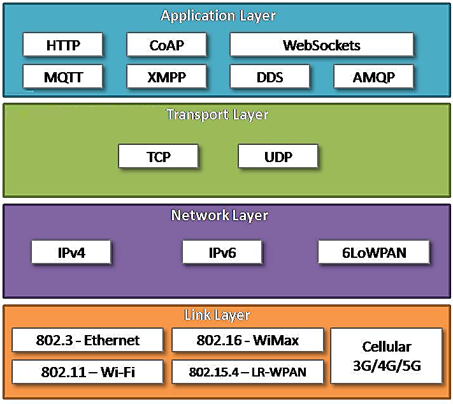
The network layers are responsible for sending of IP datagrams from the source network to the destination network. This layer performs the host addressing and packet routing. The datagrams contain the source and destination addresses which are used to route them from the source to destination across multiple networks. Host identification is done using hierarchical IP addressing schemes such as IPv4 or IPv6.
IPv4
Internet Protocol version 4 (IPv4) is the most deployed Internet protocol that is used to identify the devices on a network using a hierarchical addressing scheme.
IPv4 uses a 32-bit address scheme that allows a total of 232 (4,294,967,296) addresses. As more and more devices got connected to the Internet, these addresses got exhausted in the year 2011. IPv4 has been succeeded by IPv6.
The IP protocols establish connections on packet networks, but do not guarantee delivery of packets. Guaranteed delivery and data integrity are handled by the upper layer protocols (such as TCP).
IPv6
Internet Protocol version 6 (IPv6) is the newest version of Internet protocol and successor to IPv4.
IPv6 uses a 128-bit address scheme that allows a total of 2128 (approximately 3.4 × 1038) addresses.
6LoWPAN
6LoWPAN (IPv6 over Low Power Wireless Personal Area Networks) brings IP protocol to the low-power devices which have limited processing capability.
6LoWPAN operates in the 2.4 GHz frequency range and provides data transfer rates of 250 Kb/s.
6LoWPAN works with the IEEE 802.15.4 link layer protocol and defines compression mechanisms for IPv6 datagrams over IEEE 802.15.4-based networks.
More from "IoT And Its Applications"
Machine-to-Machine (M2M) Communication
Learn about Machine-to-Machine (M2M) communication, its architecture, M2M gateways, communication networks, and applications in modern IoT systems.
IoT Levels – Level 6 Architecture
Learn about the architecture, working, and applications of IoT Level-6 systems, where multiple independent IoT nodes communicate directly with the cloud and a centralized controller manages the entire system.
IoT Levels – Level 5 Architecture
Learn about the architecture, working, and applications of IoT Level-5 systems, where multiple end nodes communicate through a coordinator node for cloud-based storage, analytics, and monitoring.