Transport Layer Protocols for Internet of Things (IoT)

Transport Layer
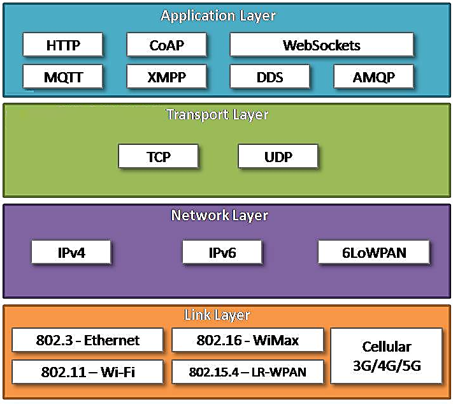
The transport layer protocols provide end-to-end message transfer capability independent of the underlying network. The message transfer capability can be set up on connections, either using handshakes (as in TCP) or without handshakes/acknowledgements (as in UDP). The transport layer provides functions such as error control, segmentation, flow control and congestion control.
TCP
Transmission Control Protocol (TCP) is the most widely used transport layer protocol that is used by web browsers (along with HTTP and HTTPS application layer protocols), email programs (SMTP application layer protocol), and file transfer (FTP).
TCP is a connection-oriented and stateful protocol.
While the IP protocol deals with sending packets, TCP ensures reliable transmission of packets in order. TCP also provides error detection capability so that duplicate packets can be discarded, and lost packets are retransmitted.
The flow control capability of TCP ensures that the rate at which the sender sends the data is not too high for the receiver to process.
The congestion control capability of TCP helps in avoiding network congestion and congestion collapse, which can lead to degradation of network performance.
UDP
Unlike TCP, which requires carrying out an initial setup procedure, UDP is a connectionless protocol.
UDP is useful for time-sensitive applications that have very small data units to exchange and do not want the overhead of connection setup.
UDP is a transaction-oriented and stateless protocol.
UDP does not provide guaranteed delivery, ordering of messages, and duplicate elimination. Higher levels of protocols can ensure reliable delivery or ensure that connections created are reliable.
More from "IoT And Its Applications"
Machine-to-Machine (M2M) Communication
Learn about Machine-to-Machine (M2M) communication, its architecture, M2M gateways, communication networks, and applications in modern IoT systems.
IoT Levels – Level 6 Architecture
Learn about the architecture, working, and applications of IoT Level-6 systems, where multiple independent IoT nodes communicate directly with the cloud and a centralized controller manages the entire system.
IoT Levels – Level 5 Architecture
Learn about the architecture, working, and applications of IoT Level-5 systems, where multiple end nodes communicate through a coordinator node for cloud-based storage, analytics, and monitoring.