
Fundamentals of Electric Circuits: Current, Voltage, Power and Energy

Fundamentals of Electric Circuits
Today we live in a predominantly electrical world. Electrical technology is a driving force behind developments across every engineering discipline. From computing systems and communication networks to automation and power systems, electrical principles form the foundation of modern technology.
At the heart of this technology lies circuit analysis. A strong understanding of electric circuits provides insight into cause and effect relationships, feedback mechanisms, stability, oscillations, and controlled energy transfer.
An electric circuit (or electric network) is an interconnection of electrical elements linked together in a closed path so that electric current may continuously flow.
Electric Charge
The most fundamental quantity in electric circuit analysis is electric charge.
Charge is the intrinsic property of matter responsible for electrical phenomena.
The charge on one electron is:
One coulomb corresponds to approximately:
Charge is represented by:
Electric Current
Electric current is defined as the time rate of change of electric charge.
where:
- = current (ampere, A)
- = charge (coulomb, C)
- = time (seconds)
The unit of current is the ampere (A):
Current represents the rate at which electric charge flows past a given point in a circuit.
Voltage (Potential Difference)
The two fundamental variables in electric circuits are current and voltage.
If current flows into one terminal of an element, a potential difference exists between its terminals. This potential difference is called voltage.
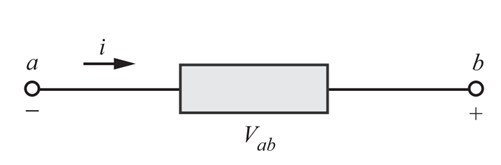
Voltage is defined as:
The work done in moving a positive charge of one coulomb from one terminal of an element to another.
Mathematically,
where:
- = voltage (volt, V)
- = energy (joules, J)
- = charge (coulomb, C)
The unit of voltage is:
Voltage provides the driving force that enables current to flow through an electrical element.
Power in Electric Circuits
Power represents the rate at which energy is transferred.
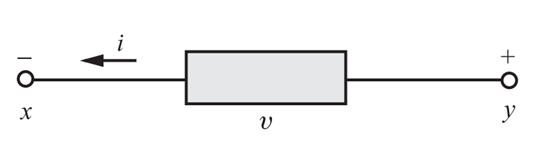
Multiplying voltage by current gives:
where:
- = power (watts, W)
The unit of power is:
Power may be positive or negative depending on the direction of current and voltage polarity:
- If current enters the positive voltage terminal → Power is absorbed
- If current leaves the positive voltage terminal → Power is supplied
Energy and Its Relation to Power
Energy is the capacity to perform work.
Energy and power are related by:
Energy is measured in joules (J).
Why These Fundamentals Matter
Understanding electric circuits, current, voltage, power, and energy is essential for:
- DC and AC circuit analysis
- Electrical machines
- Power systems
- Electronic and computing hardware
- Embedded and interdisciplinary technologies
Mastery of these core concepts develops strong analytical thinking and forms the foundation for advanced engineering studies.
Conclusion
Electrical engineering begins with clear definitions and disciplined analysis. A solid grasp of charge, current, voltage, power, and energy provides the essential framework for understanding how electrical systems operate.
These fundamentals serve as the cornerstone for deeper exploration into circuits, machines, and modern technological systems.
More from "Basic Electrical Engineering"
Power in AC Circuits
An introduction to active power, reactive power, apparent power, and power relationships in AC circuits.
Series RLC Circuit
An introduction to series RLC circuits, impedance, phase angle, reactance, and AC circuit behaviour.
Series RC Circuit
An introduction to series RC circuits, impedance, phase angle, phasor relationships, and voltage-current analysis in AC circuits.