Resistors, Inductors and Capacitors in Electric Circuits
Resistors, Inductors and Capacitors in Electric Circuits
Resistors, inductors, and capacitors are fundamental passive elements in electric circuits. Understanding their physical meaning and governing equations is essential for circuit analysis.
Resistors
Resistance is the physical property of an element that opposes the flow of electric current. It is represented by the symbol .
For a uniform wire:
where:
- = resistivity
- = length of the conductor
- = cross-sectional area
The unit of resistance is the ohm (Ω).
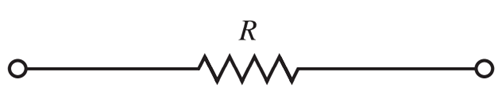
A conductor has a resistance of 1 Ω if a current of 1 A flows when 1 V is applied across its terminals.
Ohm’s Law
where:
- = voltage
- = current
- = resistance
Ohm’s law states that current is directly proportional to voltage, provided temperature and physical conditions remain constant.
Limitations of Ohm’s Law
- It is empirical and not universal.
- Some materials are non-ohmic.
- Resistivity varies with temperature.
Power in a Resistor
Since , the power absorbed is always positive.
Thus, a resistor is a passive element.
Inductors
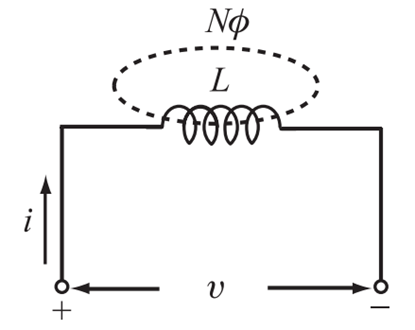
An inductor produces a voltage proportional to the rate of change of current:
where:
- = inductance (Henry)
Energy Stored in an Inductor
Power:
Energy stored:
Since , the inductor stores energy in a magnetic field and is a passive element.
Capacitors
A capacitor consists of two conducting plates separated by a dielectric.
Capacitance is defined as:
Current–Voltage Relation
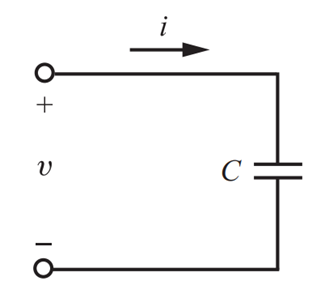
Energy Stored in a Capacitor
Since , the capacitor stores energy in an electric field and is also a passive element.
Summary
- A resistor dissipates energy.
- An inductor stores energy in a magnetic field.
- A capacitor stores energy in an electric field.
All three are classified as passive elements because they do not generate energy but either dissipate or store it.
More from "Basic Electrical Engineering"
Power in AC Circuits
An introduction to active power, reactive power, apparent power, and power relationships in AC circuits.
Series RLC Circuit
An introduction to series RLC circuits, impedance, phase angle, reactance, and AC circuit behaviour.
Series RC Circuit
An introduction to series RC circuits, impedance, phase angle, phasor relationships, and voltage-current analysis in AC circuits.