
Linear Elements in Electric Circuits: Superposition and Homogeneity
Linear Elements in Electric Circuits
In electric circuit analysis, understanding whether an element behaves linearly or nonlinearly is fundamental. A linear element is one that satisfies the principles of superposition and homogeneity. These two properties together define linear behavior in electrical systems.
Principle of Superposition
Consider an element where:
- The excitation is the current
- The response is the voltage
If the element is subjected to a current , it produces a response .
If it is subjected to another current , it produces a response .
For the element to be linear, the following must hold:
This means that when two excitations are applied simultaneously, the total response must be equal to the sum of the individual responses.
This property is known as the principle of superposition.
Principle of Homogeneity
Linearity also requires that scaling the input scales the output proportionally.
If the excitation is multiplied by a constant factor , such that:
then the response must also be scaled by the same factor:
This proportional scaling is called the principle of homogeneity.
Definition of a Linear Element
An electrical element is considered linear if:
- It satisfies superposition
- It satisfies homogeneity
Mathematically, the relationship between voltage and current must be linear.
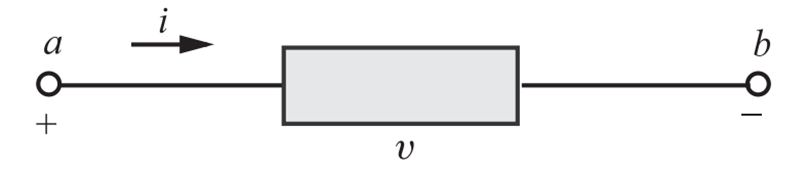
For example, an ideal resistor follows Ohm’s Law:
Since this relationship is directly proportional, a resistor is a linear element (assuming constant resistance).
Passive and Active Elements
Circuit elements can also be classified based on energy behavior.
Passive Elements
Passive elements absorb energy.
Examples include:
- Resistors
- Inductors
- Capacitors
These elements do not generate energy but may store or dissipate it.
Active Elements
Active elements supply energy to a circuit.
Examples include:
- Independent voltage sources
- Independent current sources
These elements are capable of delivering power to other parts of the circuit.
Why Linearity Matters
Linearity greatly simplifies circuit analysis because:
- Superposition can be applied
- Mathematical solutions become straightforward
- Complex circuits can be analyzed using systematic techniques
Many fundamental circuit theorems rely on the assumption of linearity.
Conclusion
Linear elements form the backbone of basic circuit analysis. By satisfying the principles of superposition and homogeneity, they allow predictable and proportional relationships between excitation and response. Understanding linearity is essential before moving toward advanced topics in electrical engineering and system analysis.
More from "Basic Electrical Engineering"
Power in AC Circuits
An introduction to active power, reactive power, apparent power, and power relationships in AC circuits.
Series RLC Circuit
An introduction to series RLC circuits, impedance, phase angle, reactance, and AC circuit behaviour.
Series RC Circuit
An introduction to series RC circuits, impedance, phase angle, phasor relationships, and voltage-current analysis in AC circuits.