
j Notation and Complex Numbers in AC Circuits
j Notation and Complex Numbers in AC Circuits
In AC circuit analysis, sinusoidal voltages and currents are conveniently represented using complex numbers.
The imaginary operator used in electrical engineering is represented by the symbol .
The symbol is used instead of because the symbol usually represents electric current.
The use of notation simplifies mathematical calculations involving sinusoidal quantities and phase angles.
Imaginary Operator
The imaginary operator is defined as:
Therefore,
Higher powers of follow a cyclic pattern:
and the cycle repeats.
Complex Numbers
A complex number consists of:
- Real part
- Imaginary part
A complex number is represented as:
where:
- = real part
- = imaginary part
Example:
Here:
- Real part =
- Imaginary part =
Complex Plane
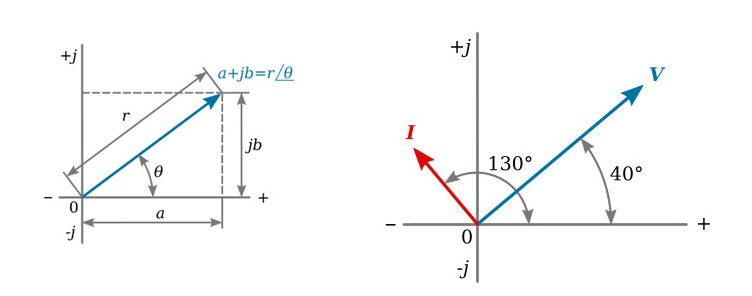
A complex number can be represented graphically on a complex plane.
- Horizontal axis → real axis
- Vertical axis → imaginary axis
The real component is measured along the X-axis and the imaginary component along the Y-axis.
Equality of Complex Numbers
Two complex numbers are equal only when their real and imaginary parts are separately equal.
If
then,
and
Addition and Subtraction of Complex Numbers
Addition
If
and
then,
Example
Subtraction
Example
Multiplication of Complex Numbers
If
and
then,
Since,
therefore,
Example
Conjugate of a Complex Number
The conjugate of a complex number is obtained by changing the sign of the imaginary part.
If
then its conjugate is:
Example
If
then,
Magnitude of a Complex Number
The magnitude or modulus of a complex number is:
Example
For
Polar Form of Complex Numbers
A complex number may also be represented in polar form as:
where:
- = magnitude
- = phase angle
The phase angle is given by:
Thus,
Euler’s Formula
Euler’s formula establishes the relationship between exponential and trigonometric forms.
Hence,
or
Phase Representation Using j Operator
Multiplication by represents a phase shift of:
Thus:
- Multiplication by → leading by
- Multiplication by → lagging by
This property is very useful in AC circuit analysis and phasor representation.
Advantages of j Notation
- Simplifies AC calculations
- Simplifies phase angle representation
- Reduces trigonometric complexity
- Useful in phasor algebra
- Makes sinusoidal analysis easier
Applications of j Notation
- AC circuit analysis
- Phasor representation
- Power system calculations
- Signal analysis
- Communication engineering
Summary
- is the imaginary operator used in electrical engineering.
- Complex numbers consist of real and imaginary parts.
- Complex numbers can be represented in rectangular and polar forms.
- Euler’s formula relates exponential and trigonometric forms.
- Multiplication by represents a phase shift of .
- j notation simplifies the analysis of sinusoidal quantities.
More from "Basic Electrical Engineering"
Power in AC Circuits
An introduction to active power, reactive power, apparent power, and power relationships in AC circuits.
Series RLC Circuit
An introduction to series RLC circuits, impedance, phase angle, reactance, and AC circuit behaviour.
Series RC Circuit
An introduction to series RC circuits, impedance, phase angle, phasor relationships, and voltage-current analysis in AC circuits.