
Voltage and Current Values of a Sine Wave
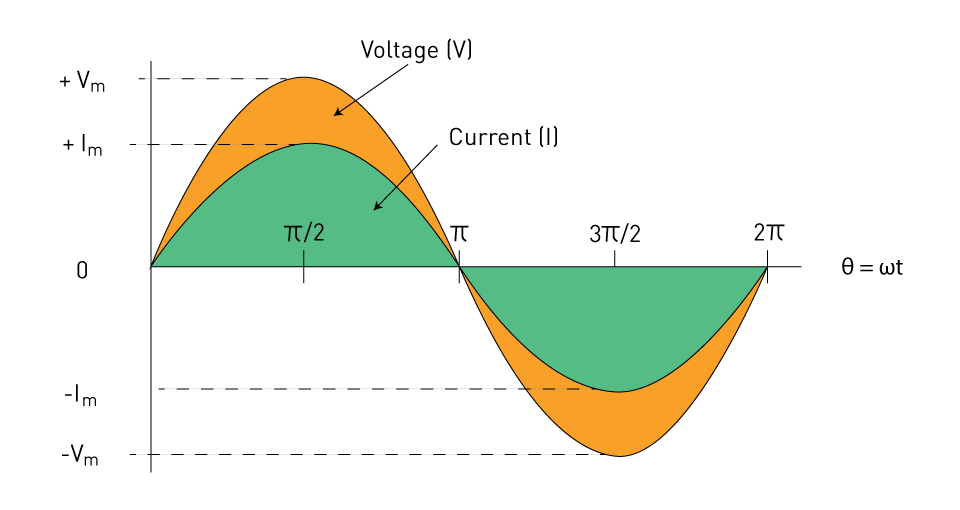
Voltage and Current Values of a Sine Wave
As the magnitude of the waveform is not constant, the waveform can be measured in different ways.
These are:
- Instantaneous value
- Peak value
- Peak-to-peak value
- Root mean square (RMS) value
- Average value
Instantaneous Value
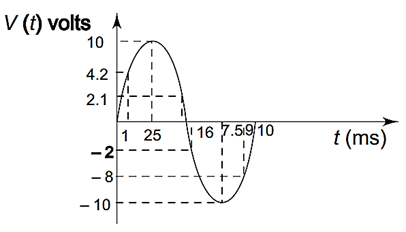
Consider the sine wave shown in Fig. 2.7.
At any given time, it has some instantaneous value. This value is different at different points along the waveform.
During the positive cycle, the instantaneous values are positive and during the negative cycle, the instantaneous values are negative.
For example:
- At time , the value is
- At time , the value is
- At time , the value is
- At time , the value is
The instantaneous value of a sine wave is given by:
where:
- = instantaneous value
- = maximum value
- = angular frequency
- = time
Peak Value
The peak value of a sine wave is the maximum value of the wave during the positive half-cycle or the maximum value during the negative half-cycle.
Since these two values are equal in magnitude, a sine wave is characterised by a single peak value.
In Fig. 2.7, the peak value of the sine wave is:
Peak-to-Peak Value
The peak-to-peak value of a sine wave is the value from the positive peak to the negative peak.
In Fig. 2.7, the peak-to-peak value is:
In general,
Average Value
In general, the average value of any function with period is given by:
That means the average value of a curve in the X-Y plane is the total area under the complete curve divided by the distance of the curve.
The average value of a sine wave over one complete cycle is always zero.
Therefore, the average value of a sine wave is defined over a half-cycle and not over a full-cycle period.
The average value of the sine wave is the total area under the half-cycle curve divided by the distance of the curve.
The average value of the sine wave is given by:
Taking outside the integral,
Integrating,
Substituting the limits,
Since,
and
Therefore,
or
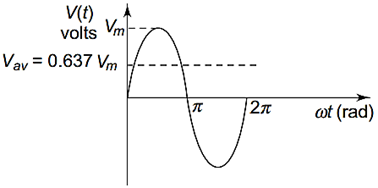
The average value of a sine wave is shown by the dotted line in Fig. 2.8.
Root Mean Square Value or Effective Value
The root mean square (RMS) value of a sine wave is a measure of the heating effect of the wave.
When a resistor is connected across a dc voltage source, a certain amount of heat is produced in the resistor in a given time.
A similar resistor is connected across an ac voltage source for the same time.
The value of the ac voltage is adjusted such that the same amount of heat is produced in the resistor as in the case of the dc source.
This value is called the RMS value.
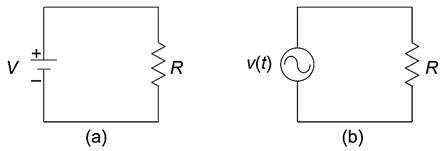
Thus, the RMS value of a sine wave is equal to the dc voltage that produces the same heating effect.
In general, the RMS value of any function with period is given by:
For a sinusoidal waveform,
Substituting into the RMS equation,
Taking outside the integral,
Using the trigonometric identity,
Therefore,
Integrating,
Since the sine term becomes zero over a complete cycle,
or
Peak Factor
The peak factor of any waveform is defined as the ratio of the peak value of the wave to the RMS value of the wave.
For a sinusoidal waveform,
Form Factor
Form factor of a waveform is defined as the ratio of RMS value to the average value of the wave.
For a sinusoidal waveform,
Summary
- Instantaneous value changes continuously with time.
- Peak value is the maximum value of the waveform.
- Peak-to-peak value is twice the peak value.
- Average value of a sine wave is defined over a half-cycle.
- RMS value represents the effective heating value.
- Peak factor is the ratio of peak value to RMS value.
- Form factor is the ratio of RMS value to average value.
More from "Basic Electrical Engineering"
Power in AC Circuits
An introduction to active power, reactive power, apparent power, and power relationships in AC circuits.
Series RLC Circuit
An introduction to series RLC circuits, impedance, phase angle, reactance, and AC circuit behaviour.
Series RC Circuit
An introduction to series RC circuits, impedance, phase angle, phasor relationships, and voltage-current analysis in AC circuits.