
Representation of Sinusoidal Waveforms
Representation of Sinusoidal Waveforms
Many a time, alternating voltages and currents are represented by a sinusoidal wave, or simply a sinusoid.
It is a very common type of alternating current (ac) and alternating voltage. The sinusoidal wave is generally referred to as a sine wave.
Basically, an alternating voltage (current) waveform is defined as the voltage (current) that fluctuates with time periodically, with change in polarity and direction.
Any periodic waveform can be written in terms of sinusoidal function according to Fourier theorem.
Another reason is that its derivatives and integrals are also sinusoids. A sinusoidal function is easy to analyse. Lastly, the sinusoidal function is easy to generate, and it is more useful in the power industry.
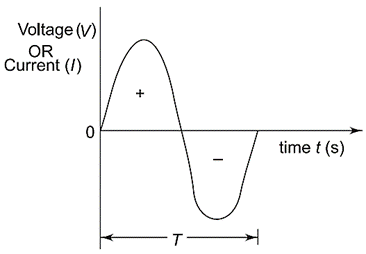
The shape of a sinusoidal waveform is shown in Fig. 2.1.
Characteristics of Sinusoidal Waveform
The waveform may be either a current waveform or a voltage waveform.
As seen from Fig. 2.1, the wave changes its magnitude and direction with time.
If we start at time , the wave goes to a maximum value and returns to zero and then decreases to a negative maximum value before returning to zero.
The sine wave changes with time in an orderly manner.
During the positive portion of voltage, the current flows in one direction; and during the negative portion of voltage, the current flows in the opposite direction.
The complete positive and negative portion of the wave is one cycle of the sine wave.
Time is designated by .
The time taken for any wave to complete one full cycle is called the time period .
In general, any periodic wave constitutes a number of such cycles.
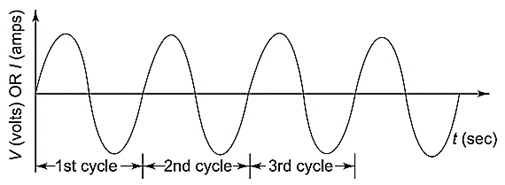
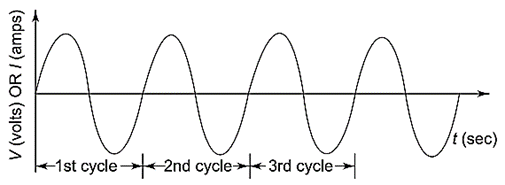
For example, one cycle of a sine wave repeats a number of times as shown in Fig. 2.2.
Measurement of Time Period
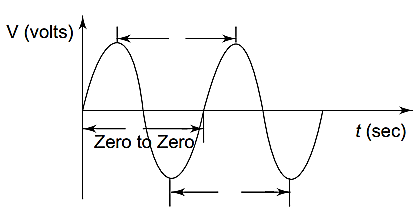
The period can be measured in the following different ways as shown in Fig. 2.3.
- From zero crossing of one cycle to zero crossing of the next cycle
- From positive peak of one cycle to positive peak of the next cycle
- From negative peak of one cycle to negative peak of the next cycle
Frequency of a Wave
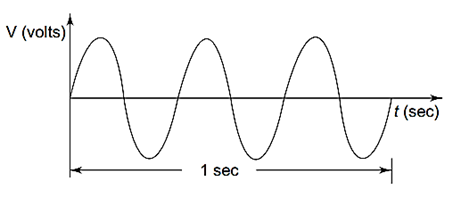
The frequency of a wave is defined as the number of cycles that a wave completes in one second.
In Fig. 2.4, the sine wave completes three cycles in one second.
Frequency is measured in hertz.
- One hertz is equivalent to one cycle per second.
- 60 hertz means 60 cycles per second.
In Fig. 2.4, the frequency denoted by is .
The relation between time period and frequency is given by:
or
Phase Shift
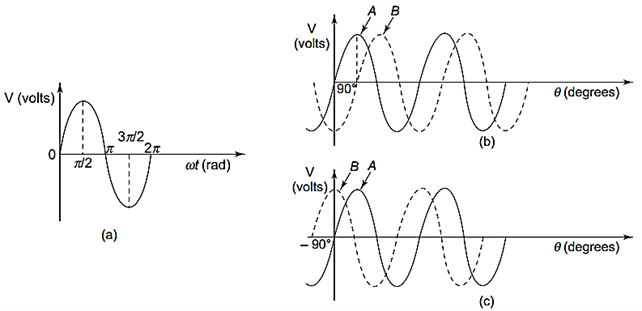
When the sine wave is shifted left or right with reference to the wave shown in Fig. 2.5(a), there occurs a phase shift.
Figure 2.5(b) and (c) show the phase shifts of a sine wave.
In Fig. 2.5(b), the sine wave is shifted to the right by or radians.
There is a phase angle of between waveforms A and B.
Here, waveform B is lagging behind waveform A by .
In other words, waveform A is leading waveform B by .
In Fig. 2.5(c), waveform A is lagging behind waveform B by .
In both cases, the phase difference is .
Representation of a Sine Wave
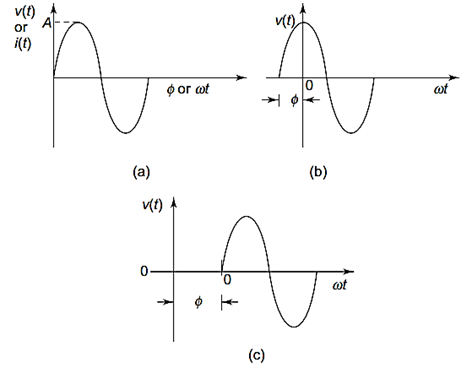
A sine wave is graphically represented as shown in Fig. 2.6(a).
The amplitude of a sine wave is represented on the vertical axis.
The angular measurement in degrees or radians is represented on the horizontal axis.
Amplitude is the maximum value of the voltage or current on the Y-axis.
In general, the sine wave is represented by the equation:
where:
- = instantaneous value
- = maximum or peak value
- = angular frequency
- = time
The above equation states that any point on the sine wave represented by an instantaneous value is equal to the maximum value times the sine of the angular frequency at that point.
For example, if a certain sine wave voltage has a peak value of , the instantaneous voltage at a point radians along the horizontal axis can be calculated as:
Sine Wave with Phase Shift
When a sine wave is shifted to the left of the reference wave by a certain angle , the general expression becomes:
When a sine wave is shifted to the right of the reference wave by a certain angle , the general expression becomes:
Different Values of a Waveform
As the magnitude of the waveform is not constant, the waveform can be measured in different ways.
These are:
- Instantaneous value
- Peak value
- Peak-to-peak value
- Root mean square (RMS) value
- Average value
Summary
- Sinusoidal waveforms are widely used to represent alternating voltages and currents.
- A sine wave changes magnitude and direction periodically.
- The time taken to complete one cycle is called the time period.
- Frequency is the number of cycles completed per second.
- Phase shift represents angular displacement between waveforms.
- A sinusoidal waveform is mathematically represented using sine functions.
More from "Basic Electrical Engineering"
Power in AC Circuits
An introduction to active power, reactive power, apparent power, and power relationships in AC circuits.
Series RLC Circuit
An introduction to series RLC circuits, impedance, phase angle, reactance, and AC circuit behaviour.
Series RC Circuit
An introduction to series RC circuits, impedance, phase angle, phasor relationships, and voltage-current analysis in AC circuits.