
Maximum Power Transfer Theorem
Maximum Power Transfer Theorem
In circuit analysis, we are sometimes interested in determining the maximum power that a circuit can supply to the load.
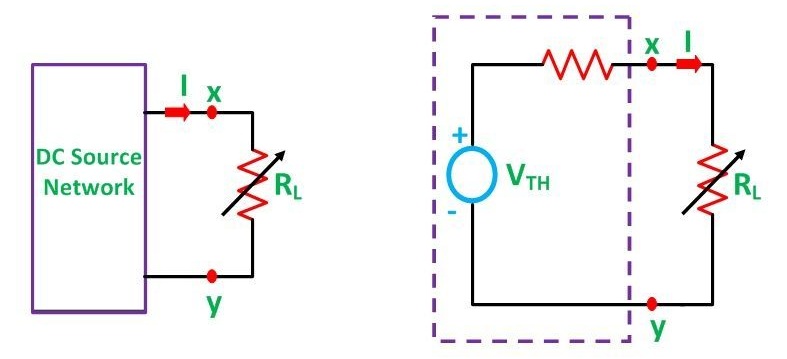
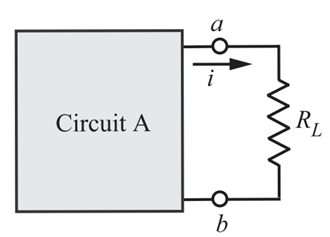
Consider a linear circuit connected to a load resistance .
Circuit is replaced by its Thevenin equivalent circuit as seen from terminals and .
We wish to find the value of the load resistance such that the maximum power is delivered to it.
Power Delivered to the Load
The current flowing through the load is:
where:
- = Thevenin voltage
- = Thevenin resistance
- = load resistance
The power delivered to the load is given by:
Substituting the value of current,
Therefore,
Condition for Maximum Power Transfer
Assuming that and are fixed for a given source, the maximum power depends only on .
To determine the value of that maximizes power, differentiate with respect to and equate the derivative to zero.
Thus,
On solving,
Hence, the load resistance must be equal to the Thevenin resistance for maximum power transfer.
Maximum Power Delivered
The maximum power transferred to the load is obtained by substituting:
in the power equation.
Thus,
Statement of Maximum Power Transfer Theorem
The Maximum Power Transfer theorem states that:
The maximum power delivered by a source represented by its Thevenin equivalent circuit is attained when the load resistance is equal to the Thevenin resistance .
Applications of Maximum Power Transfer Theorem
- Communication systems
- Audio amplifier design
- Impedance matching
- Electronic circuits
- Transmission systems
Advantages
- Ensures optimum power delivery to the load.
- Useful in matching source and load impedances.
- Widely used in communication engineering.
Limitations
- Efficiency at maximum power transfer is only 50%.
- Not suitable for power transmission systems where efficiency is important.
- Applicable mainly to linear bilateral networks.
Summary
- Maximum power transfer occurs when load resistance equals source resistance.
- The theorem is based on Thevenin equivalent circuits.
- The condition for maximum power transfer is:
- The maximum power delivered to the load is:
- The theorem is widely used in impedance matching applications.
More from "Basic Electrical Engineering"
Power in AC Circuits
An introduction to active power, reactive power, apparent power, and power relationships in AC circuits.
Series RLC Circuit
An introduction to series RLC circuits, impedance, phase angle, reactance, and AC circuit behaviour.
Series RC Circuit
An introduction to series RC circuits, impedance, phase angle, phasor relationships, and voltage-current analysis in AC circuits.