
Network Reduction Techniques
Network Reduction Techniques
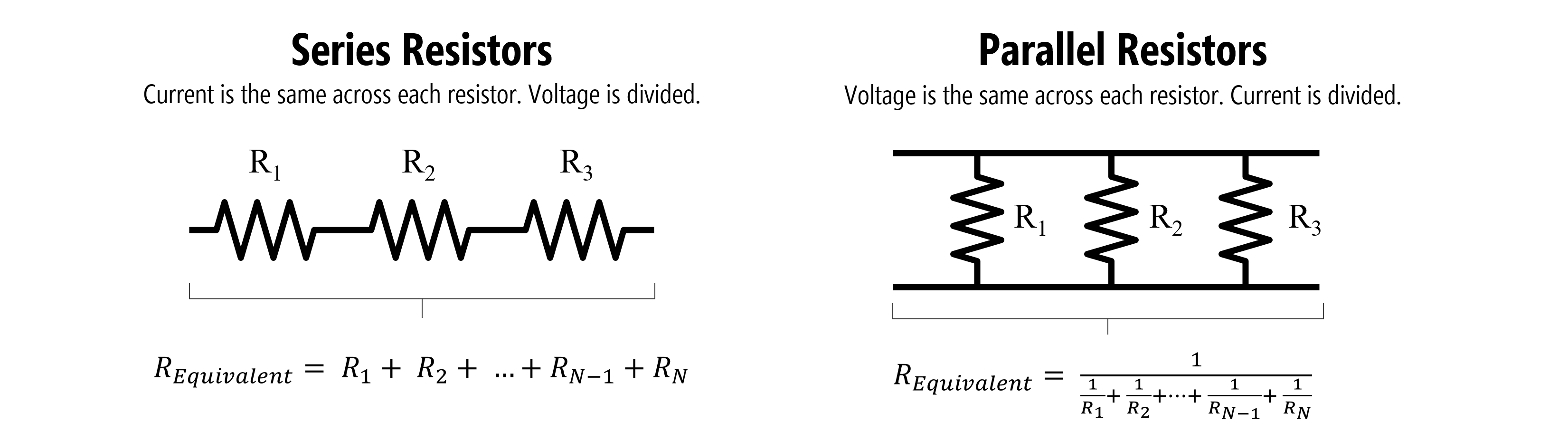
In this section, we shall give the formula for reducing the networks consisting of resistors connected in series or parallel.
Resistors in Series
Resistors are in series whenever the flow of charge, called the current, must flow through devices sequentially.
According to Ohm’s law, the current through the resistance is directly proportional to the voltage and inversely proportional to the resistance. The voltage in a circuit is
where:
- I = current
- R = resistance
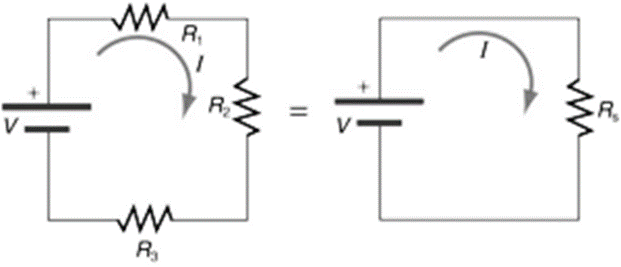
Now, we are calculating the individual voltage drop across the individual resistances (R_1), (R_2), and (R_3).
The voltage drop across:
The sum of total voltage is equal to:
Substituting the voltage drops,
or
Now we must convert the individual resistances into an equivalent single resistance (R_s).
We have,
Therefore,
So,
For “N” number of resistances, the total resistance will be:
Resistors in Parallel
Figure shows resistors in parallel connected to a voltage source.
Resistors are in parallel when each resistor is connected directly to the voltage source by connecting wires having negligible resistance. Each resistor thus has the full voltage of the source applied to it. Each resistor draws the same current it would if it alone were connected to the voltage source.
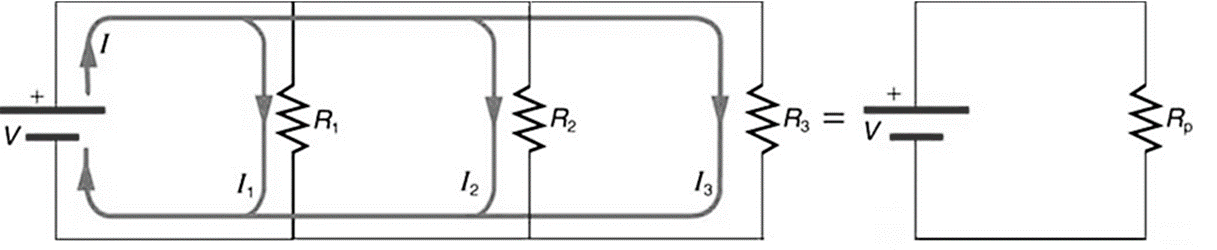
To find an expression for the equivalent parallel resistance (R_p), let us consider the currents that flow and how they are related to resistance.
Since each resistor in the circuit has the full voltage, the currents flowing through the individual resistors are:
Conservation of charge implies that the total current (I) produced by the source is the sum of these currents:
Substituting the expressions for the individual currents gives:
Using Ohm’s law for the equivalent resistance,
Therefore,
Generalizing to any number of resistors,
When resistors are connected in parallel, more current flows from the source than would flow for any of them individually, and so the total resistance is lower.
Summary
- Resistors in series carry the same current.
- Equivalent resistance in series is the sum of individual resistances.
- Resistors in parallel have the same voltage across them.
- Equivalent resistance in parallel is obtained using reciprocal relations.
- Parallel combinations always produce a lower equivalent resistance.
More from "Basic Electrical Engineering"
Power in AC Circuits
An introduction to active power, reactive power, apparent power, and power relationships in AC circuits.
Series RLC Circuit
An introduction to series RLC circuits, impedance, phase angle, reactance, and AC circuit behaviour.
Series RC Circuit
An introduction to series RC circuits, impedance, phase angle, phasor relationships, and voltage-current analysis in AC circuits.