
Kirchhoff’s Laws in Electric Circuits
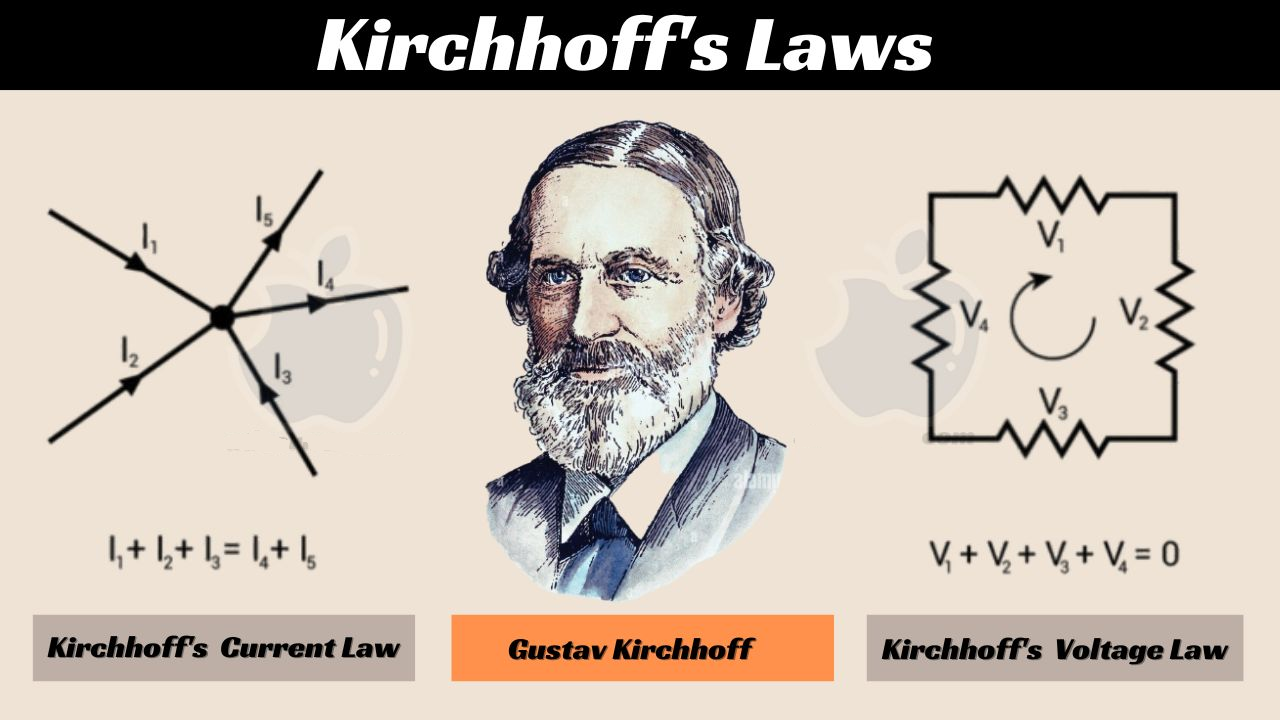
Kirchhoff’s Laws in Electric Circuits
As electric networks become more complex, the direct application of Ohm’s law becomes tedious and time-consuming. To simplify the analysis of such circuits, Kirchhoff’s laws are used.
developed two fundamental laws for electrical network analysis:
- Kirchhoff’s Current Law (KCL)
- Kirchhoff’s Voltage Law (KVL)
These laws form the basis for systematic circuit analysis.
Basic Circuit Terminologies
Before studying Kirchhoff’s laws, it is important to understand some commonly used circuit terms.
Node
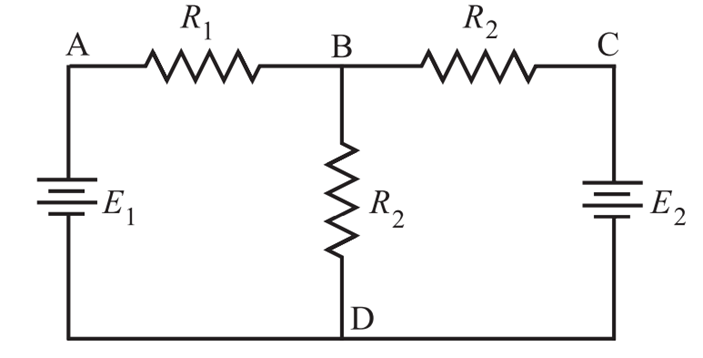
A node is an equipotential point where two or more circuit elements are connected.
Junction
A junction is a point in a circuit where three or more circuit elements meet.
Branch
A branch is the part of a network lying between two junction points.
Loop
A loop is any closed conducting path in a circuit.
Mesh
A mesh is the simplest possible loop that cannot be further divided into smaller loops.
Kirchhoff’s Current Law (KCL)
Kirchhoff’s Current Law states that:
The algebraic sum of currents entering any node is zero.
Consider a node where currents are entering and leaving.

The algebraic sum of currents can be written as:
Rearranging,
Thus,
The sum of currents entering a node is equal to the sum of currents leaving the node.
Mathematical Representation
KCL is based on the principle of conservation of charge. Since a node cannot store charge, the total incoming current must equal the total outgoing current.
Kirchhoff’s Voltage Law (KVL)
Kirchhoff’s Voltage Law states that:
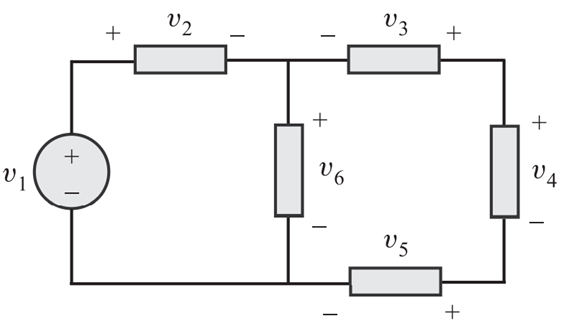
The algebraic sum of all voltages around any closed loop is zero.
For a loop containing voltages,
where:
- = voltage across the branch
Sign Convention
While traversing a loop:
- Voltage rise → considered negative
- Voltage drop → considered positive
The total voltage rises and drops in a closed loop always balance to zero.
Example Equation
For a simple loop,
or,
Importance of Kirchhoff’s Laws
Kirchhoff’s laws are widely used in:
- Network analysis
- Mesh analysis
- Nodal analysis
- AC and DC circuit calculations
- Electrical and electronic system design
These laws simplify the analysis of complex electrical circuits.
Summary
- KCL states that the total current entering a node equals the total current leaving it.
- KVL states that the algebraic sum of voltages around a closed loop is zero.
- These laws form the foundation of electrical circuit analysis.
More from "Basic Electrical Engineering"
Power in AC Circuits
An introduction to active power, reactive power, apparent power, and power relationships in AC circuits.
Series RLC Circuit
An introduction to series RLC circuits, impedance, phase angle, reactance, and AC circuit behaviour.
Series RC Circuit
An introduction to series RC circuits, impedance, phase angle, phasor relationships, and voltage-current analysis in AC circuits.