
Power in AC Circuits
Power in AC Circuits
In AC circuits, power is classified into:
- Active power
- Reactive power
- Apparent power
The relationship between voltage, current, and phase angle determines the nature of power in the circuit.
Active Power
The actual amount of power being used or dissipated in a circuit is called:
- True power
- Active power
- Real power
It is measured in:
It is symbolized by the capital letter:
Power is consumed only in resistance.
The expression for active power is:
where:
- = RMS voltage
- = RMS current
- = phase angle between voltage and current
Reactive Power
Reactive loads such as inductors and capacitors dissipate or consume zero average power.
However, since they draw current and drop voltage, they appear to consume power.
This “phantom” or fictitious power is called reactive power.
Reactive power is measured in:
It is represented by:
The reactive power does not perform any useful work in the circuit.
A pure inductor and a pure capacitor do not consume any average power because:
During one half cycle, the power received from the source is stored, and during the next half cycle, the same power is returned to the source.
The expression for reactive power is:
Apparent Power
The product of RMS voltage and RMS current is known as apparent power.
It is measured in:
It is represented by:
The expression for apparent power is:
Power Triangle
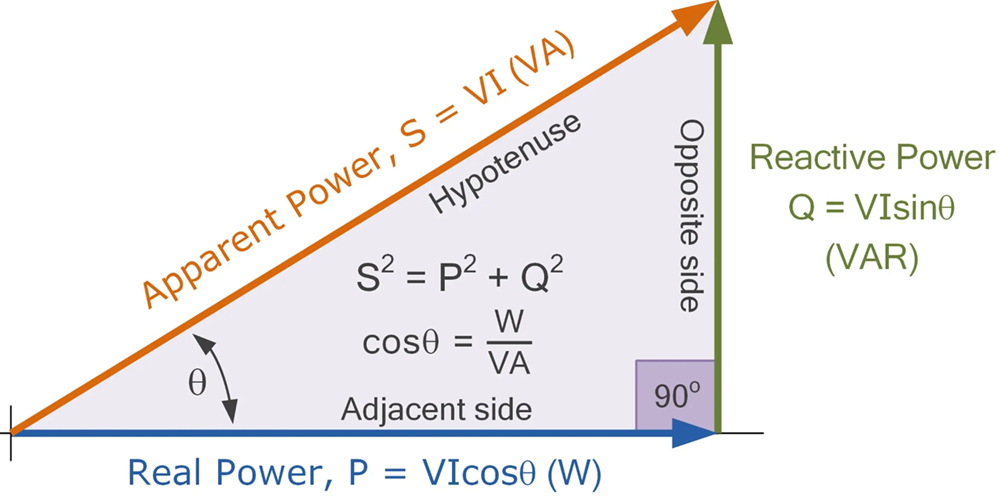
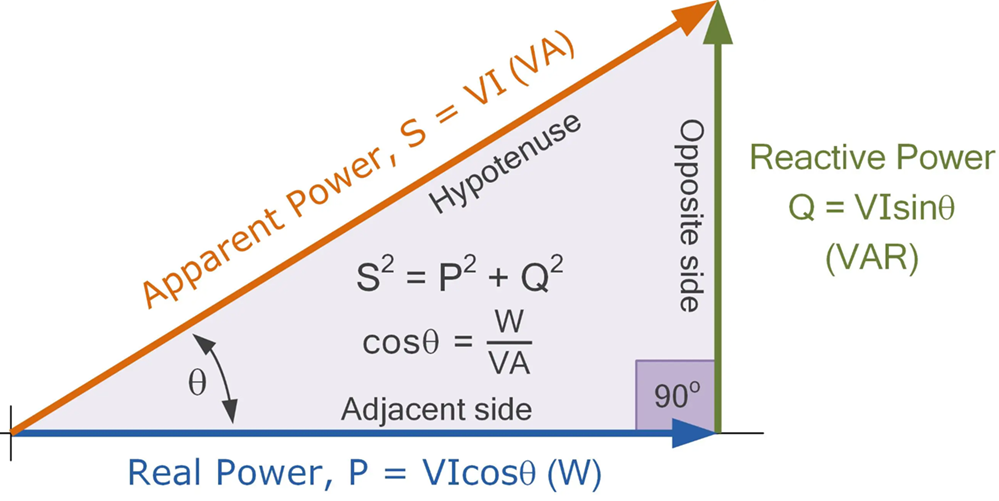
The relationship between active power, reactive power, and apparent power can be represented by a power triangle.
In the power triangle:
- Active power forms the horizontal side.
- Reactive power forms the vertical side.
- Apparent power forms the hypotenuse.
Using Pythagoras theorem,
Therefore,
Power Factor
The cosine of the phase angle between voltage and current is called the power factor.
Also,
Lagging Power Factor
- Occurs in inductive circuits
- Current lags voltage
Leading Power Factor
- Occurs in capacitive circuits
- Current leads voltage
Unity Power Factor
Occurs in pure resistive circuits.
Significance of Power Factor
A high power factor is desirable because:
- It improves system efficiency.
- It reduces power losses.
- It improves voltage regulation.
- It reduces conductor size.
Summary of Power Equations
Active Power
Reactive Power
Apparent Power
Characteristics of Different Powers
Active Power
- Performs useful work
- Consumed in resistors
- Measured in watts
Reactive Power
- Alternately stored and returned
- Associated with inductors and capacitors
- Measured in VAr
Apparent Power
- Total power supplied by source
- Combination of active and reactive powers
- Measured in VA
Summary
- AC power is classified into active, reactive, and apparent power.
- Active power performs useful work.
- Reactive power does not perform useful work.
- Apparent power is the product of RMS voltage and current.
- The power factor determines the effectiveness of power utilization.
- The power triangle relates active, reactive, and apparent powers.
More from "Basic Electrical Engineering"
Series RLC Circuit
An introduction to series RLC circuits, impedance, phase angle, reactance, and AC circuit behaviour.
Series RC Circuit
An introduction to series RC circuits, impedance, phase angle, phasor relationships, and voltage-current analysis in AC circuits.
Series RL Circuit
An introduction to series RL circuits, impedance, phase angle, phasor relationships, and voltage-current analysis in AC circuits.