
Superposition Theorem in Electric Circuits
Superposition Theorem in Electric Circuits
The principle of superposition is applicable only for linear systems.
The concept of superposition can be explained mathematically by the following response and excitation principle:
then,
The quantity to the left of the arrow indicates the excitation and to the right, the system response.
Thus, we can state that a device, if excited by a current (i_1), will produce a response (v_1).
Similarly, an excitation (i_2) will cause a response (v_2). Then if we use an excitation (i_1 + i_2), we will find a response (v_1 + v_2).
The principle of superposition can reduce a complicated problem to several easier problems each containing only a single independent source.
Superposition Theorem
Superposition theorem states that:
In any linear circuit containing multiple independent sources, the current or voltage at any point in the network may be calculated as algebraic sum of the individual contributions of each source acting alone.
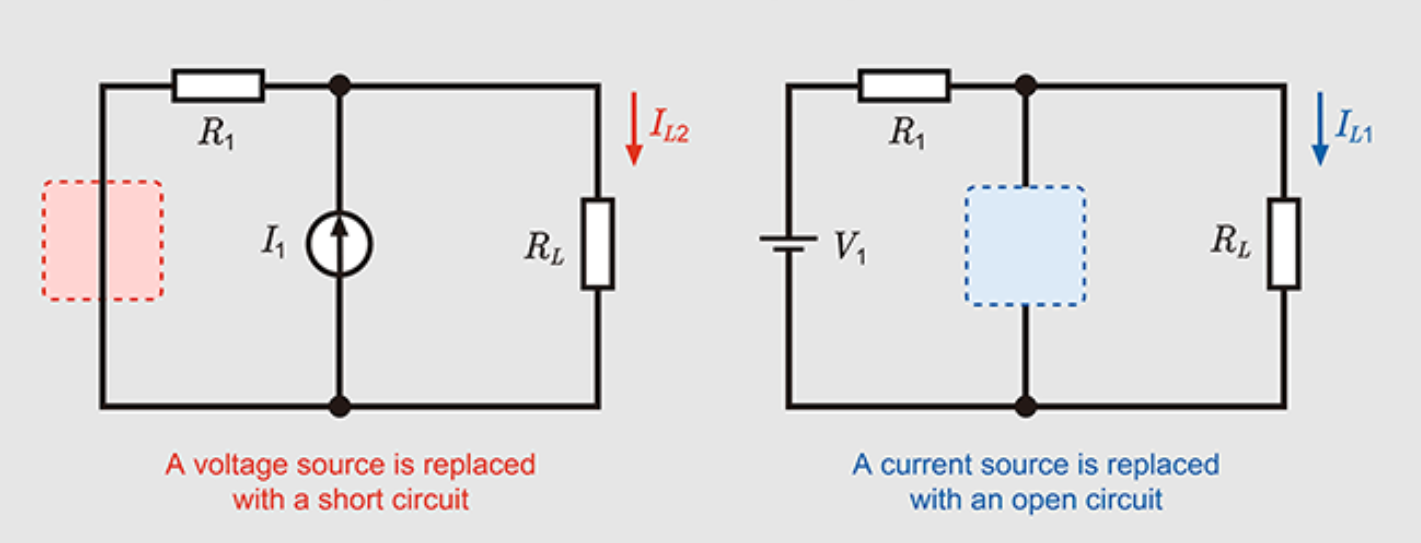
When determining the contribution due to a particular independent source, we disable all the remaining independent sources.
That is:
- All remaining voltage sources are replaced with short circuits.
- All remaining current sources are replaced with open circuits.
Also, it is important to note that if a dependent source is present, it must remain active (unaltered) during the process of superposition.
Action Plan
-
In a circuit comprising many independent sources, only one source is allowed to be active in the circuit, while the rest are deactivated (turned off).
-
To deactivate a voltage source, replace it with a short circuit.
-
To deactivate a current source, replace it with an open circuit.
-
The response obtained by applying each source one at a time are then added algebraically to obtain the final solution.
Advantages of Superposition Theorem
- Simplifies the analysis of multi-source circuits.
- Reduces a complex circuit into simpler circuits.
- Helps in understanding the contribution of each source individually.
- Applicable to both AC and DC linear circuits.
Limitations
Superposition is a fundamental property of linear equations and, therefore, can be applied to any effect that is linearly related to the cause.
The superposition principle applies only to:
- Current
- Voltage
in a linear circuit.
However, it cannot be used to determine power because power is a non-linear function.
The theorem is applicable only to linear bilateral networks.
Summary
- Superposition theorem is applicable only to linear circuits.
- Only one independent source is considered active at a time.
- Voltage sources are replaced by short circuits during deactivation.
- Current sources are replaced by open circuits during deactivation.
- Individual responses are added algebraically to obtain the total response.
- The theorem cannot be directly applied for power calculations.
More from "Basic Electrical Engineering"
Power in AC Circuits
An introduction to active power, reactive power, apparent power, and power relationships in AC circuits.
Series RLC Circuit
An introduction to series RLC circuits, impedance, phase angle, reactance, and AC circuit behaviour.
Series RC Circuit
An introduction to series RC circuits, impedance, phase angle, phasor relationships, and voltage-current analysis in AC circuits.